Bottom line
VEV Multi Collagen Peptides is the cheapest collagen I can find that carries real third-party certification. At roughly $0.45 per 10 g of collagen, it undercuts Vital Proteins, Sports Research and Thorne on the only comparison that actually matters — cost per gram of collagen, not cost per tub.
It is not the best collagen for everyone. If you need a product screened for banned substances (drug-tested athletes), VEV does not carry that certification. If you want one scoop and no fish smell, look elsewhere. And if you are buying the D3 + K2 10,000 IU line, read that section before you swallow one — that dose is well above the standard upper limit for unsupervised daily use.
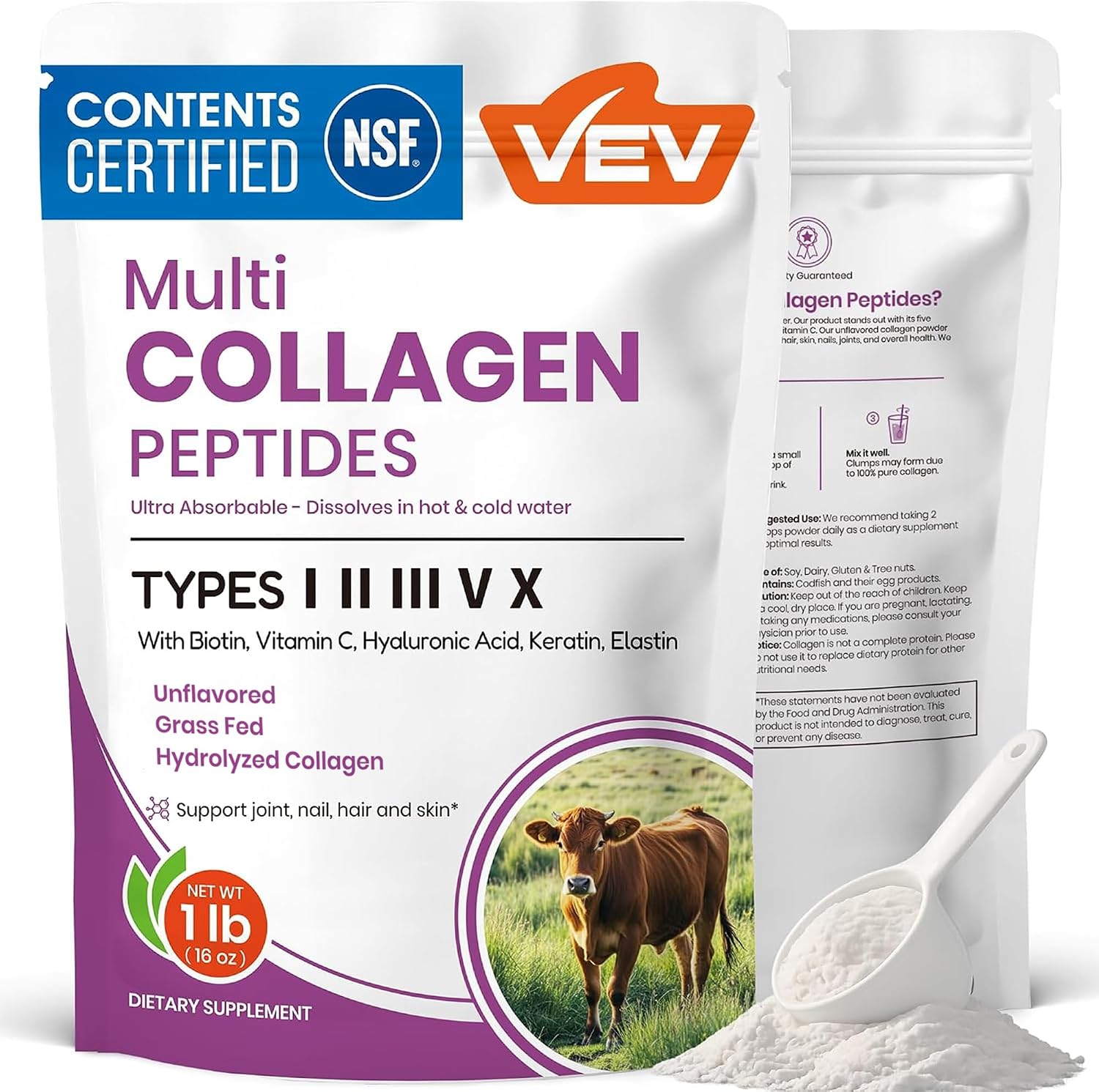 VEV Multi Collagen Peptides, 16 oz / 41 servings. NSF Contents Certified mark is printed on the front panel.
The shortlist
| Your situation | What to buy | Why |
|---|---|---|
| Want lowest cost per gram of certified collagen | VEV Multi Collagen, 41 servings | ~$0.45 / 10 g, NSF certified |
| Same, but buying in bulk | VEV Multi Collagen, 82 servings | ~$0.44 / 10 g — marginal gain |
| Drug-tested athlete (WADA, NCAA, military) | Vital Proteins or Thorne | Need Certified for Sport, which VEV lacks |
| Just want vitamin D and can read a blood test | VEV D3+K2 10,000 IU, 120 ct | Cheapest per softgel, but see the dose warning |
How we assessed it
Supplement reviews are where the internet lies most, so here is exactly what this one rests on.
- Reconciled the label against the serving size. Two scoops = 10.9 g collagen. That number drives every cost calculation below.
- Verified the certification claim against NSF’s own public description of what Contents Certified covers, and checked what it does not cover.
- Cross-checked cost against an independent price index — Verified Supplement Data independently priced the same tub in November 2026 and reached the same per-gram figure.
- Read the clinical literature on collagen peptides as a category, so we can tell you which claims have trial support and which are marketing.
Where a claim comes from the brand rather than a certifier or a published study, we say so instead of repeating it as fact. Nothing below is medical advice.
The label math
Two scoops of VEV delivers 10.9 g of collagen peptides, from five sources:
| Collagen type | Typical source in this formula | Commonly marketed for |
|---|---|---|
| Type I | Grass-fed bovine hide | Skin, hair, nails, bone |
| Type II | Chicken bone broth | Joint comfort |
| Type III | Bovine hide | Skin elasticity, blood vessels |
| Type V | Eggshell membrane | Hair, cornea, cell surfaces |
| Type X | Eggshell membrane | Cartilage |
The formula also lists vitamin C, hyaluronic acid, biotin, keratin and elastin. Here is the honest caveat no affiliate page will give you: the amounts of those five add-ins are not broken out anywhere I can verify, and they are almost certainly present at cosmetic levels rather than therapeutic ones. Vitamin C at 50–90 mg would be meaningful; a sprinkle for label appeal is not. You are buying this for the collagen, so judge it on the collagen.
On dose: published trials use anywhere from 2.5 g to 15 g per day depending on the endpoint. At 10.9 g you are inside that window for skin and joint outcomes, which is more than most cheap powders can say. You do need two scoops, which is the single most annoying thing about this product.
Is the NSF mark real, or decoration?
This is the part worth understanding, because “third-party tested” is the most abused phrase in the supplement aisle.
NSF Contents Certified is a genuine certification under NSF/ANSI 173 — the American National Standard for dietary supplements. Per NSF’s own program description, certified products are verified for:
- Label accuracy — ingredients present, in the amounts claimed, with nothing undeclared
- Contaminant screening — lead, mercury, arsenic, cadmium, chromium (VI), plus microbial contaminants, mycotoxins and pesticides where relevant
- Ongoing oversight — annual facility audits and periodic retesting, not a one-time sample
That is meaningfully more than a brand testing its own product and printing a badge.
What it does not mean: Contents Certified is not NSF Certified for Sport. The Sport program additionally screens for hundreds of substances banned by WADA, the NFL, MLB and NCAA. VEV carries the Contents mark, not the Sport mark. If you are subject to drug testing, this product is not verified for you, full stop.
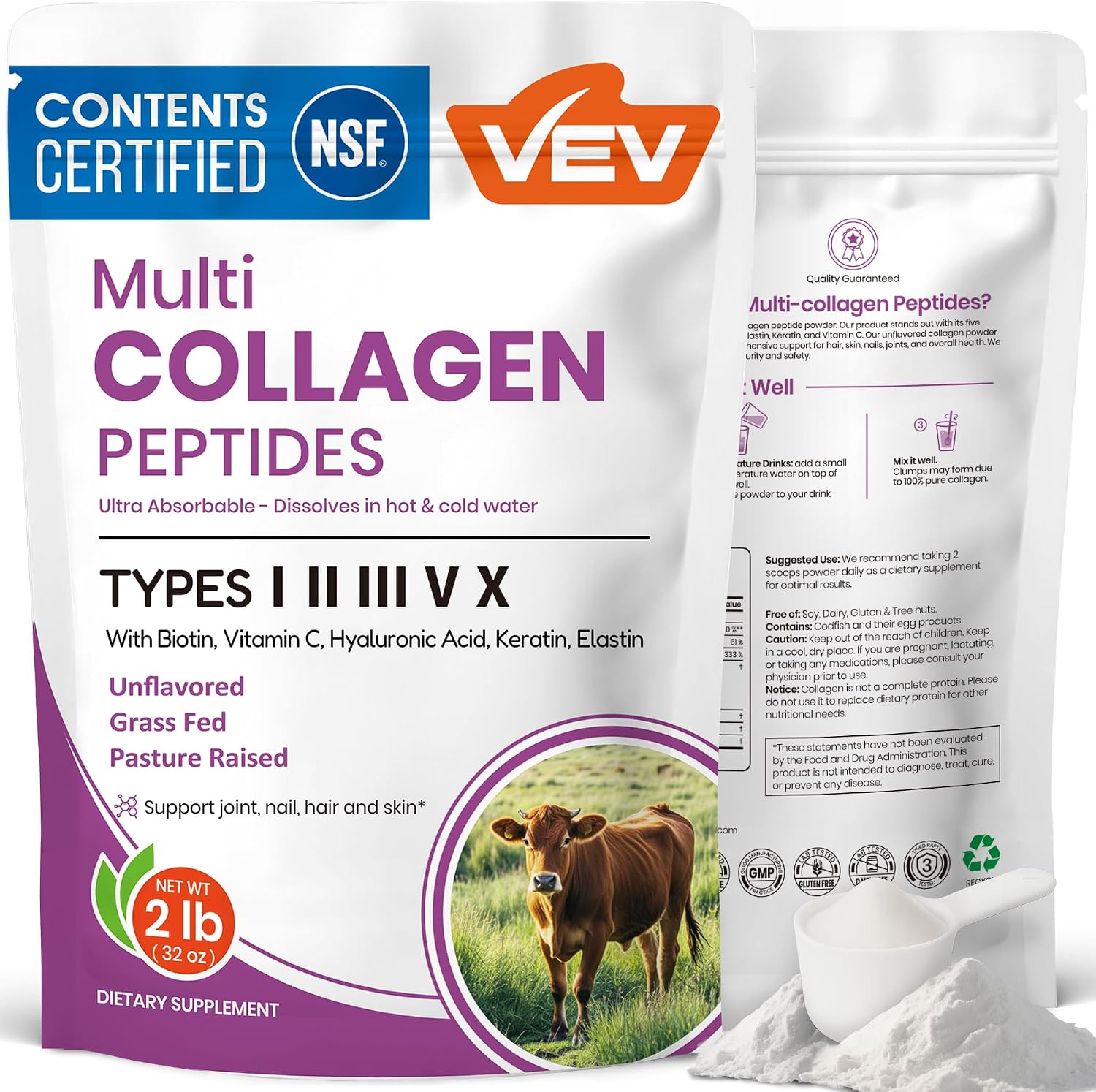 The 82-serving tub. Same formula, roughly 2% cheaper per gram than the 41-serving size — not the bulk discount you might expect.
Cost per 10 g: where VEV wins
Per-serving prices are how supplement brands hide bad value. A “cheap” powder with a 6 g scoop costs more per gram than a premium one with a 20 g scoop. So we normalized everything to cents per 10 g of collagen, the unit the trials use.
| Product | Collagen per serving | Servings | Price (Nov 2026) | Per 10 g |
|---|---|---|---|---|
| VEV Multi Collagen | 10.9 g (2 scoops) | 41 | $19.99 | ~$0.45 |
| Vital Proteins Collagen Peptides | 20 g (2 scoops) | 27 | ~$30.85 | ~$0.57 |
| Sports Research Collagen | 11 g (1 scoop) | 41 | ~$32.95 | ~$0.73 |
| Thorne Collagen Fit | 15 g (1 scoop) | 30 | ~$56.00 | ~$1.24 |
VEV is about 21% cheaper per gram than Vital Proteins and less than half the cost of Thorne. Across a year of daily 10 g dosing that gap is roughly $44 versus Vital Proteins, and about $290 versus Thorne.
Two things this table does not tell you, which matter:
- Vital Proteins is certified for sport. You are paying part of that premium for doping control. If your job or sport requires it, VEV is not a substitute at any price.
- More grams per serving is not automatically better. At a 10 g daily target, Vital Proteins’ 20 g scoop means you either take half a scoop or double your dose. VEV’s 10.9 g lands almost exactly on one convenient serving.
I would not buy the 82-serving tub expecting a real discount. At $38.99 for twice the servings, the savings round to noise. Buy it because you are tired of reordering, not to save money.
What the trials actually support
These are findings for hydrolyzed collagen peptides as a category, not for VEV specifically. VEV has not published its own trial, and any brand claiming otherwise is overselling.
| Claim | Strength | What the literature shows |
|---|---|---|
| Skin hydration and elasticity | Moderate | Improvements in randomized trials over 8–12 weeks of daily use |
| Activity-related joint pain | Moderate | Reduced pain scores over 12–24 weeks |
| Bone density | Early | One 12-month trial in postmenopausal women showed gains |
| Muscle mass with resistance training | Early | Seen at 15 g/day in older men, alongside training — VEV alone will not do this |
| Hair and nail growth | Weak | Preliminary findings only; do not buy for this |
Two practical implications. First, nothing happens in a week. Every trial that found an effect ran at least 8 weeks. Second, reported side effects across the literature are mild and mostly gastrointestinal — some people notice bloating or fullness in the first days, and it usually settles. Reviews of the evidence have not found serious adverse events even at doses far above this one.
What VEV admits on its own listing
Rather than invent reviewer complaints, here is what the brand states publicly and what the format implies:
- It may smell. VEV’s own listing says the fish-derived collagen “may have a mild natural scent, especially in hot drinks,” and suggests cold or room-temperature liquid to reduce it. This is the most common complaint category for multi-source collagen, and VEV pre-emptively owns it. If you are sensitive to smell in coffee, this is a real friction point.
- Two scoops, not one. Forty-one servings means forty-one days if you dose once daily. That is fine, but the scoop ritual is more effort than a single-scoop product.
- Unflavored means unflavored. It will not make your smoothie taste better. It also will not hide in water particularly well.
- Add-in doses are undisclosed. As above — do not buy this for the biotin or the hyaluronic acid.
The D3+K2 line: good product, larger caveat
The same brand sells a Vitamin D3 + K2 + magnesium + zinc softgel that is, on formulation, more interesting than most drugstore D3.
It delivers 10,000 IU of D3, 200 mcg of K2 as MK-7, magnesium glycinate and malate, and zinc citrate, in a coconut oil base. The magnesium inclusion is the smart part — magnesium is a cofactor in vitamin D metabolism, and most D3+K2 products skip it. K2 as MK-7 at 200 mcg is a serious dose, and pairing K2 with D3 is the standard rationale for directing calcium into bone rather than soft tissue.
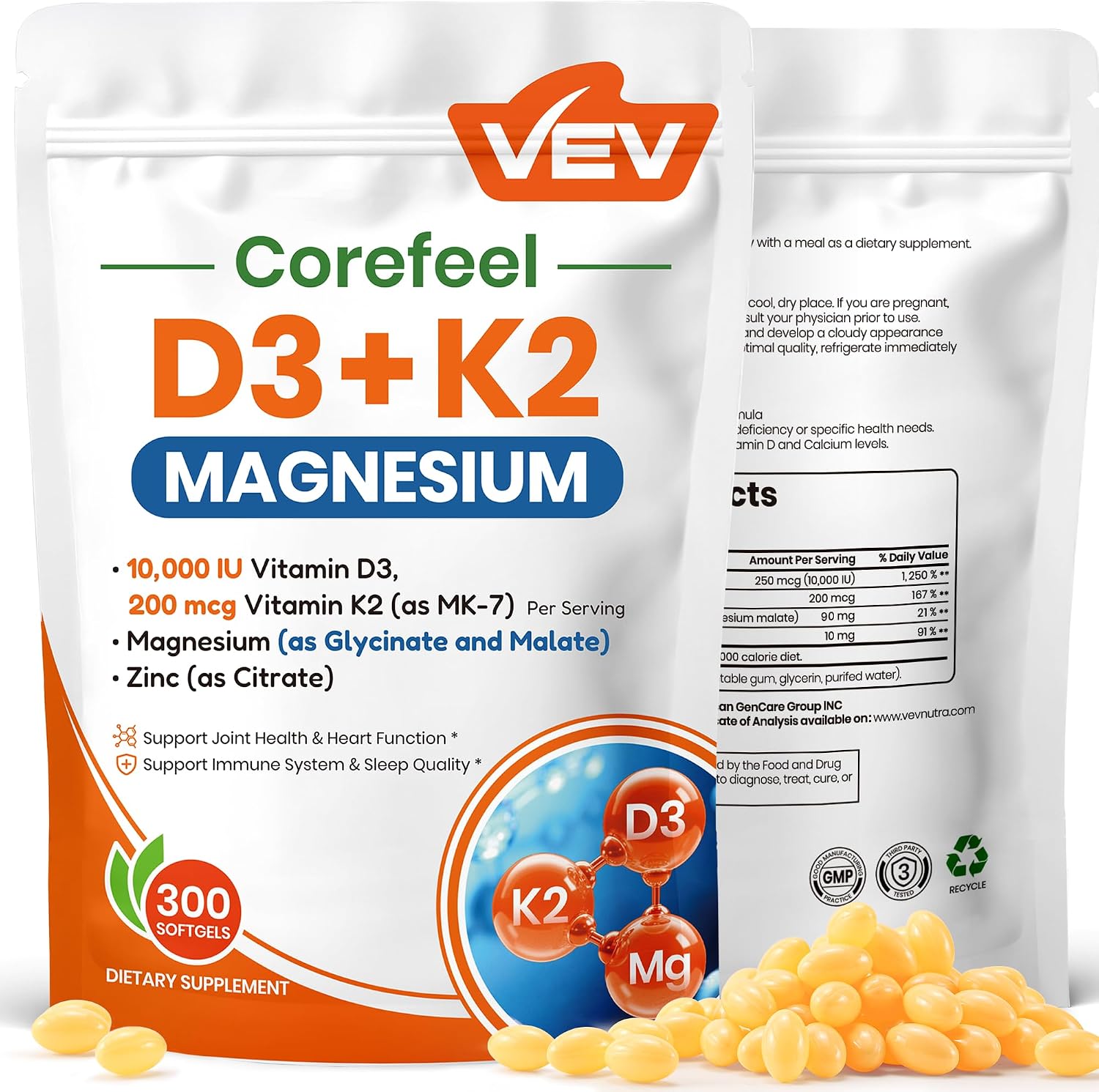 VEV Corefeel D3+K2, 10,000 IU / 200 mcg MK-7, 300 softgels.
Now the caveat, and it is not small. 10,000 IU per softgel is more than twice the 4,000 IU/day upper limit set for adults by the Institute of Medicine. That dose exists for a reason — correcting a documented deficiency under supervision — not for casual daily use by someone who has never had their 25(OH)D level tested. Vitamin D toxicity is rare but real, and it is driven by exactly this kind of unsupervised high-dose supplementation.
So: get a blood test first. If your level is low and your clinician recommends a loading dose, a 10,000 IU softgel is a convenient and cheap way to do it — the 120-count bottle works out to a few cents a day. If you just want “some vitamin D for winter,” buy a 1,000–2,000 IU product instead. The 300-count and 5,000 IU versions are the same logic at different strengths.
One more: the 16 oz “NSF Certified” collagen listing sold under a separate ASIN is priced dramatically higher than the 41-serving tub for what appears to be the same product family. Check the net weight and serving count on the page before you buy, because the premium is not obviously justified.
Who this is not for
- Drug-tested athletes. No Certified for Sport mark. Use Thorne or Vital Proteins.
- Anyone who wants a single scoop. Two scoops per serving is the design.
- People who need collagen in coffee. The fish-derived component has a scent in hot liquid, per the brand.
- Anyone expecting fast results. Eight weeks minimum before you can judge it.
- Anyone taking a high-dose vitamin D supplement already. Do not stack this D3+K2 on top without checking your total intake.
FAQ
Is VEV a real brand or an Amazon ghost brand? It is an Amazon-native supplement brand with a small catalog (collagen, D3+K2, multivitamin, creatine) and NSF Contents certification on its flagship collagen. The certification is the meaningful signal here; brand recognition is not. Small brands can be perfectly legitimate — what you want is the third-party mark, which this has.
How does it compare to Vital Proteins on quality? Different certifications for different purposes. VEV has NSF Contents Certified (label accuracy and contaminants). Vital Proteins holds NSF Certified for Sport, which adds banned-substance screening. For general consumers the difference rarely matters; for tested athletes it is decisive.
Do I need 10.9 g or more collagen? Trials used 2.5–15 g depending on the endpoint, and skin and joint outcomes cluster in the 5–10 g range. One serving of VEV sits inside that. More is not proven better for these outcomes.
Can I take this with the D3+K2? Yes, they do not interact. But check your total daily vitamin D against the 4,000 IU upper limit before adding a 10,000 IU softgel.
Is collagen safe long term? Reviews of the trial literature have not found serious adverse events, including at doses far above typical use. Mild bloating early on is the most common report. If you have kidney disease or take medications, ask your clinician — this is a protein supplement, and that matters for some conditions.
Why is the 82-serving tub not much cheaper per serving? Because the discount is genuinely small, and collagen powders are priced close to their input cost. Do not buy the bulk size expecting a meaningful saving.
Our verdict
4.4 / 5. VEV Multi Collagen does the one thing that is hardest to fake in this category: it puts a real third-party certification on the cheapest collagen per gram I have priced. The formula is sensible, the five collagen types are sourced honestly, and 10.9 g per serving is a clinically defensible dose.
It loses points for the two-scoop serving, the fish scent the brand itself warns about, undisclosed add-in quantities, and the absence of Certified for Sport. Those are real limitations, not nitpicks.
If your goal is a cost-effective daily collagen with verifiable label accuracy, this is the value pick. If your goal requires doping control, it is the wrong product — and no discount makes it right.
This is not medical advice. Talk to a clinician before starting any supplement, and get a vitamin D blood test before using the 10,000 IU product.
Keep exploring
See more independent tests in the lab, or read how scores get made.