Bottom line
The Frizzlife PD1200 is a genuinely well-certified under-sink RO system at a price that sits in the upper-middle of the category. It holds NSF/ANSI 42, 58 and 372 — three separate certifications covering taste, the RO membrane itself, and lead-free materials. Most sub-$300 RO units claim “NSF certified” while only holding 42, which covers chlorine taste and nothing else.
Two things to weigh before buying. It removes minerals along with the contaminants — that is how RO works, not a Frizzlife flaw, but it means your water ends up low in calcium and magnesium. And the annual filter cost is the real price, not the $700 sticker.
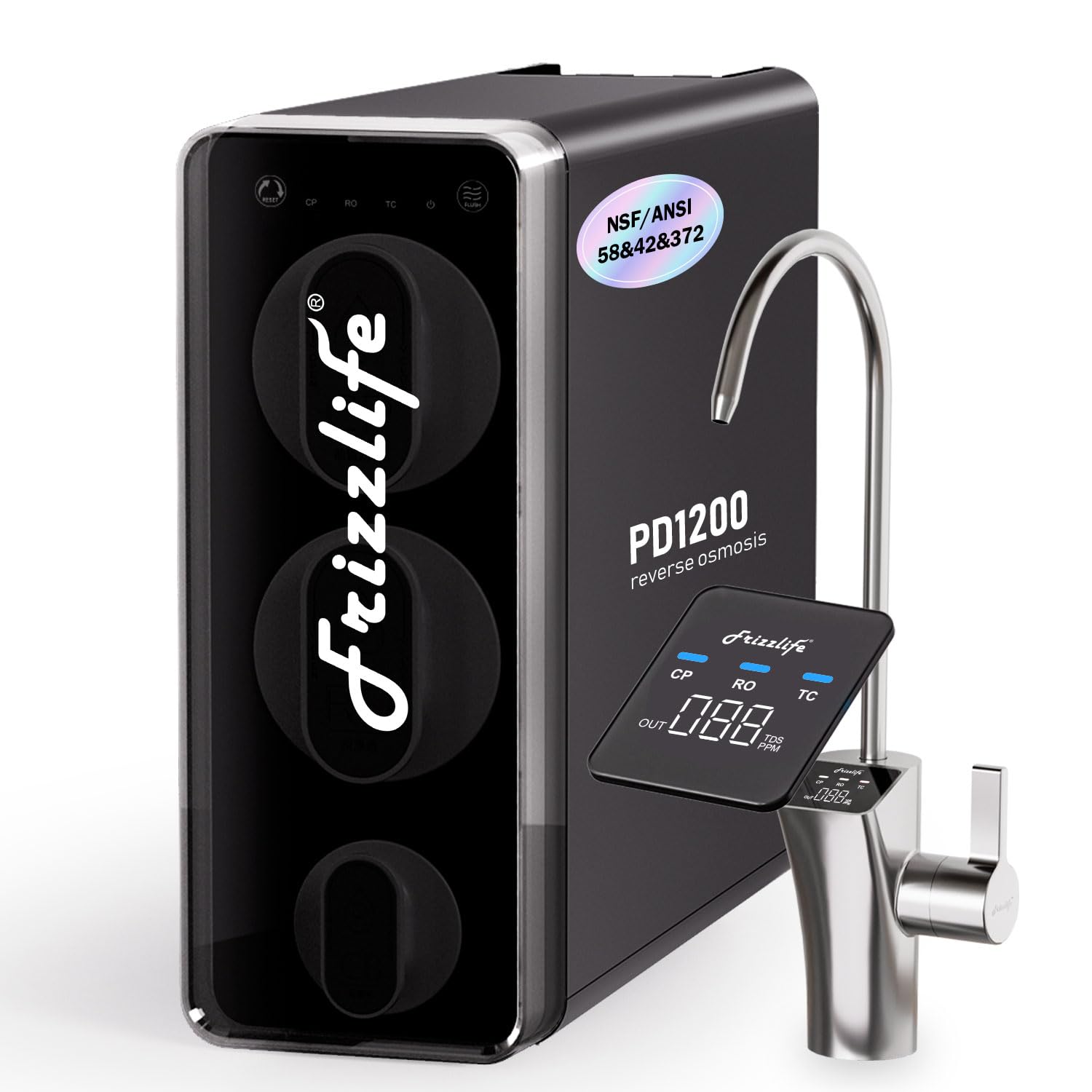 The PD1200 with its TDS-display faucet. The NSF/ANSI 42/58/372 mark is on the unit itself, not just the listing.
Current listing: Frizzlife PD1200 (1200 GPD, tankless)
The specs that matter
| Spec | PD1200 | Why it matters |
|---|---|---|
| Flow rate | 1200 GPD | ~0.83 gal/min — fills a 500 ml glass in ~5 s |
| Filtration | 11 stages, 0.0001 micron | Stage count is marketing; certification is not |
| Certifications | NSF/ANSI 42, 58, 372 | The actual performance guarantee |
| Drain ratio | 3:1 pure-to-drain | Better than the 1:3 typical of older RO |
| Tank | None (tankless) | No pressure tank to re-contaminate |
| Dimensions | 15.8”L x 6.1”W x 18.3”H | Check cabinet depth before ordering |
| TDS display | On the faucet | Live readout, genuinely useful |
| Rating | 4.6 / 5 from ~2,480 reviews | Shared across the RO product line |
How we assessed it
- Read the certification claims against the actual NSF standards — 42, 58 and 372 each verify something different, and the difference is where most listings mislead.
- Checked the drain ratio against published norms for residential RO, which run 1:3 to 1:4 on older systems.
- Reviewed the removal claims (PFAS, fluoride, arsenic, lead) against what NSF/ANSI 58 testing actually covers.
- Compared against the other names in this price band — Waterdrop, APEX, iSpring.
What the three certifications actually mean
This is the part worth understanding, because “NSF certified” is the most abused phrase in water filtration.
| Standard | What it verifies | What people think it means |
|---|---|---|
| NSF/ANSI 42 | Chlorine taste and odour, sediment, particulate reduction | “This removes everything” — it does not |
| NSF/ANSI 53 | Health effects: lead, VOCs, cysts, some PFAS | Often confused with 42 |
| NSF/ANSI 58 | RO systems: minimum 75% TDS reduction, plus specific contaminant claims | The one that actually matters here |
| NSF/ANSI 372 | Lead-free materials in wetted parts | Plumbing safety, not filtration |
NSF/ANSI 58 is the one to look for on an RO system. It requires a certified system to reduce TDS by at least 75% from a standardized feed water, and to demonstrate reduction of any contaminant it claims — lead, arsenic V, hexavalent chromium, fluoride, nitrate, radium, cadmium. In practice good RO membranes hit 90–97% TDS rejection.
Frizzlife holding 58 is meaningful. Holding 42 alongside it is normal for the carbon pre/post stages. Holding 372 means the wetted components are lead-free.
What none of these certify: bacteria. Most residential RO systems are not certified for microbiological reduction. If you are on a private well with bacterial concerns, RO is not a substitute for UV treatment or boiling.
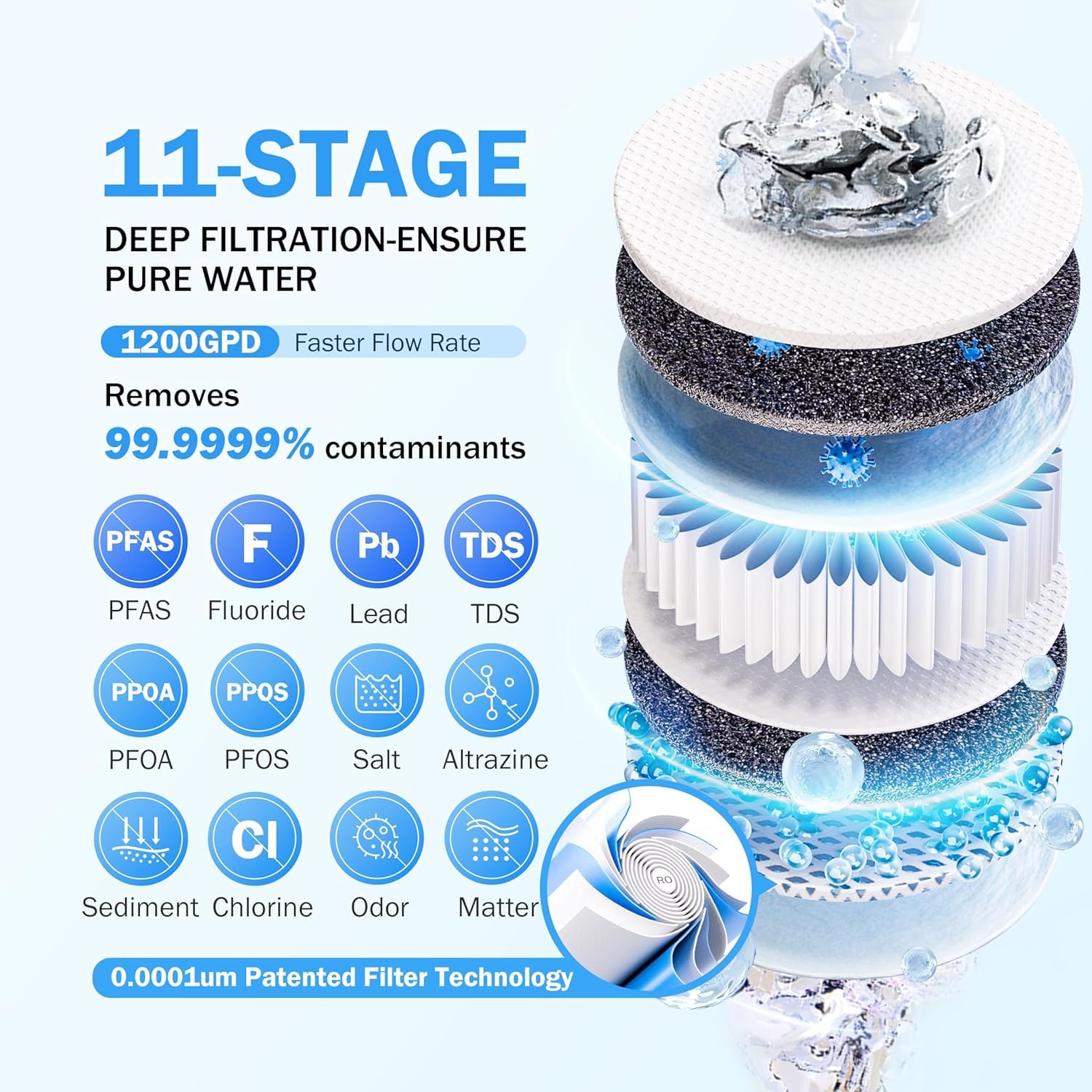 The 11-stage stack as the brand presents it. “99.9999% of contaminants” is a manufacturer figure, not an NSF claim — the certification covers specific listed contaminants at specific reduction rates, not a blanket percentage.
The drain ratio, decoded
Old RO systems are infamous for wasting water: 3 to 4 gallons down the drain for every gallon of drinking water. That is a 1:3 pure-to-waste ratio.
Frizzlife claims 3:1 — three gallons of pure water per gallon of waste, or 75% recovery. That is a genuinely different class of efficiency, achieved by recirculating reject water back through the membrane rather than flushing it once.
Two honest notes. First, the ratio is a lab condition, not a guarantee under every household pressure. Low inlet pressure degrades recovery. Second, even at 3:1 you are still sending 25% of intake to drain — the marketing phrase “saves 1200% of water” is arithmetic theatre.
The thing the bullet points leave out
RO membranes do not distinguish between contaminants and minerals. They reject calcium and magnesium as readily as they reject lead. A working RO membrane removes 95–99% of dissolved minerals, which is exactly why the water tastes flat and why remineralization cartridges exist.
Frizzlife sells a separate alkaline/mineral version of this line for that reason. The PD1200 as configured is a purification device first — if mineral content matters to you for taste, budget for a remineralization stage or buy the alkaline variant.
This is not a knock. It is the trade-off every RO buyer makes and almost no listing states.
Filter cost: the number that decides value
An RO system is a subscription with a hardware deposit. Pre- and post-filters typically need changing every 6–12 months; the membrane every 2–5 years. Across the category that runs $100–300 per year in consumables.
Frizzlife’s 11-stage design means more cartridges than a 5-stage unit — convenient in theory, more line items at replacement time in practice. Ask two questions before buying any RO system: what does a full annual filter kit cost, and are the cartridges proprietary? A $700 system with $250/year filters costs more over five years than an $850 system with $120/year filters.
How it compares
| System | Price band | Certifications | Drain ratio | Tank |
|---|---|---|---|---|
| Frizzlife PD1200 | ~$700 | 42, 58, 372 | 3:1 | Tankless |
| Waterdrop G3P800 | ~$600–700 | 42, 58, 372 | 2:1 | Tankless |
| APEC ROES-50 | ~$200 | 42, 58 | ~1:3 | Tank |
| iSpring RCC7AK | ~$250 | 42, 58 | ~1:3 | Tank + remineralizer |
The pattern is simple. Under $300 you get a tank, a slower flow rate and a worse drain ratio, but the same core 58 certification. $600–700 buys tankless design, high flow and efficient recovery. Frizzlife sits at the top of that second tier on flow rate.
If your only goal is certified contaminant removal and you do not mind waiting for the tank to refill, the APEC does the same job for a third of the price. What the extra $450 buys is flow, footprint and water efficiency.
Who should buy it
- You want verified removal, not marketing. Three certifications with 58 in the set is the strongest signal in this category.
- Your household uses a lot of drinking water. 1200 GPD tankless means no refill wait.
- Cabinet space is tight. No pressure tank is the single biggest practical advantage.
- You want to see the TDS number. The faucet display turns a vague claim into a daily reading.
Who should not
- You are on a tight budget. A $200 tank system carries the same 58 certification.
- You want minerals in your water and will not buy a remineralizer.
- You are on a private well with bacterial risk. RO is not certified for that; you need UV.
- Your inlet pressure is low. Tankless high-flow systems need adequate pressure to hit rated output.
FAQ
Is NSF/ANSI 58 the same as “NSF certified”? No. “NSF certified” alone is meaningless without the standard number. 42 is taste and sediment. 58 is the RO system standard and is the one that matters for contaminant removal.
Does it really remove PFAS? RO technology rejects PFAS effectively and the EPA recognises it as a primary treatment method. Certification is a separate question — PFAS claims sit under 58 for RO, and you should check the specific model’s listing rather than assuming.
Will the water taste different? Yes. RO water is low in dissolved minerals, which most people describe as “clean” or “flat” depending on preference. Some add a remineralization cartridge for taste and pH.
How often do filters need changing? Pre/post filters roughly every 6–12 months, membrane every 2–5 years, depending on water quality and volume. Budget $100–300/year.
Can I install it myself? Under-sink RO installation is a DIY-able job if you are comfortable with a supply-line tee and a drain saddle. If not, a plumber is a one-hour call.
Does it need electricity? Yes — tankless high-flow RO systems use a pump to hit 1200 GPD. That means a nearby outlet, which is worth checking before ordering.
Our verdict
4.4 / 5.
The PD1200 earns its score on the least glamorous dimension: it holds the right certifications and states them precisely. NSF/ANSI 58 with 42 and 372 alongside is a real performance guarantee, and the 3:1 drain ratio is a genuine improvement over the tank-based systems most people still buy.
It loses points for price relative to certified tank systems, for the mineral loss it does not advertise, and for an 11-stage design that adds cartridges without adding certified performance beyond 58.
Buy it if you want verified filtration, high flow and no tank. Skip it if you are price-sensitive (the APEC does the certified work for a third) or you want minerals in your water without extra hardware.
Prices and specifications change; verify the current figure and model variant before ordering.
Keep exploring
See more independent tests in the lab, or read how scores get made.