Bottom line
At around $130, FelixKing sells you two things most budget chairs won’t: a 300 lb weight rating and a 5-year warranty. The Hbada chair that dominates this price tier is also $130 — but it tops out at 250 lb and does not carry a five-year guarantee. If you are a heavier user, or you just want the warranty, that gap is the whole decision.
Two things you should know before buying. There is no headrest, despite the listing claiming “5 supporting points including head” — the fifth point is the top of a tall backrest, not a pillow. And the “$130 chair” has no height- or angle-adjustable armrests, only flip-up ones. If armrest adjustment is non-negotiable for you, this is the wrong chair.
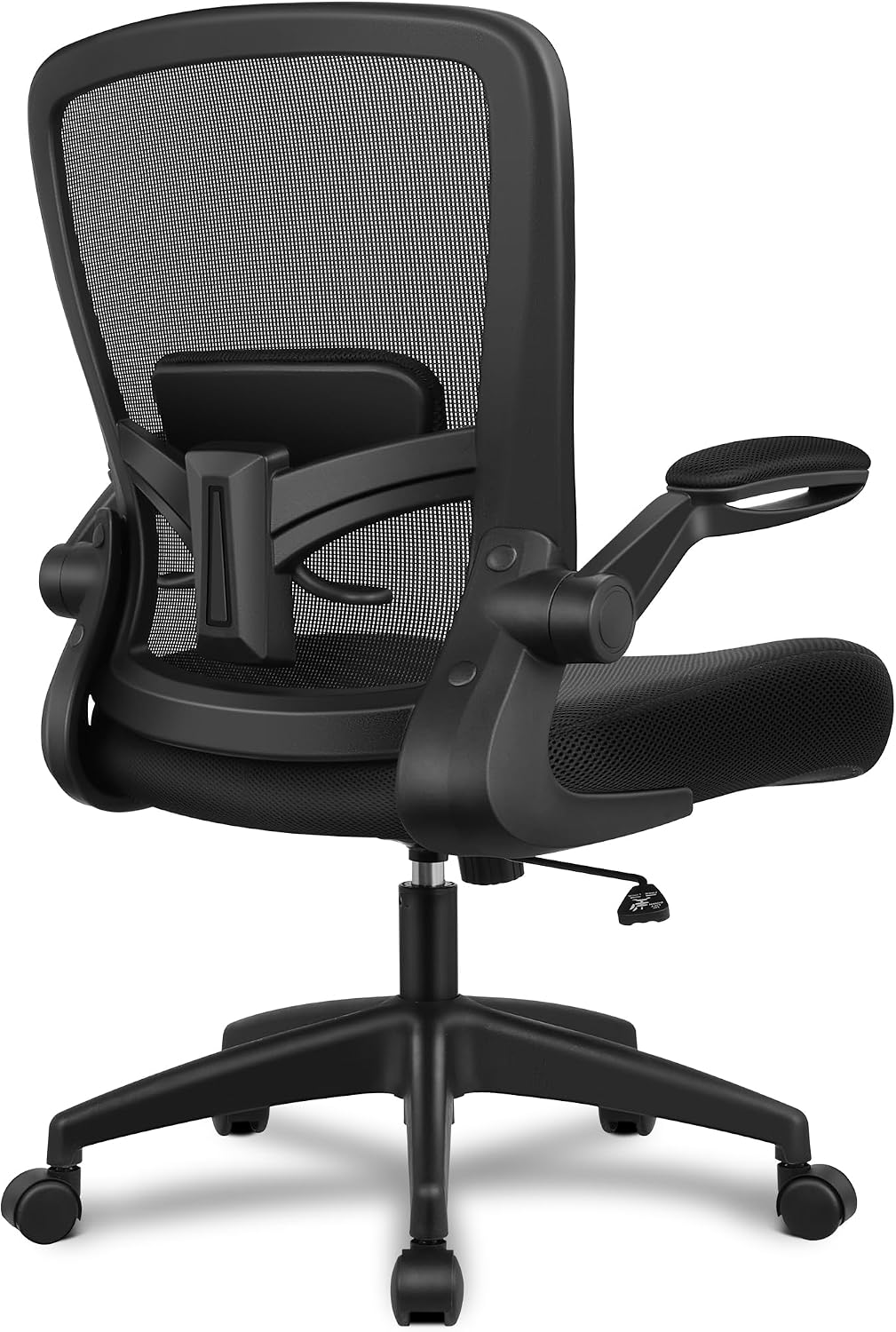 The Black variant. Note the adjustable lumbar pad on the backrest and the flip-up armrests — but no headrest.
Current listing: FelixKing Office Chair (Black, 300 lb, 5-yr warranty). Other colours run a little higher — Slate Grey and Pink sit around $149 at the time of writing.
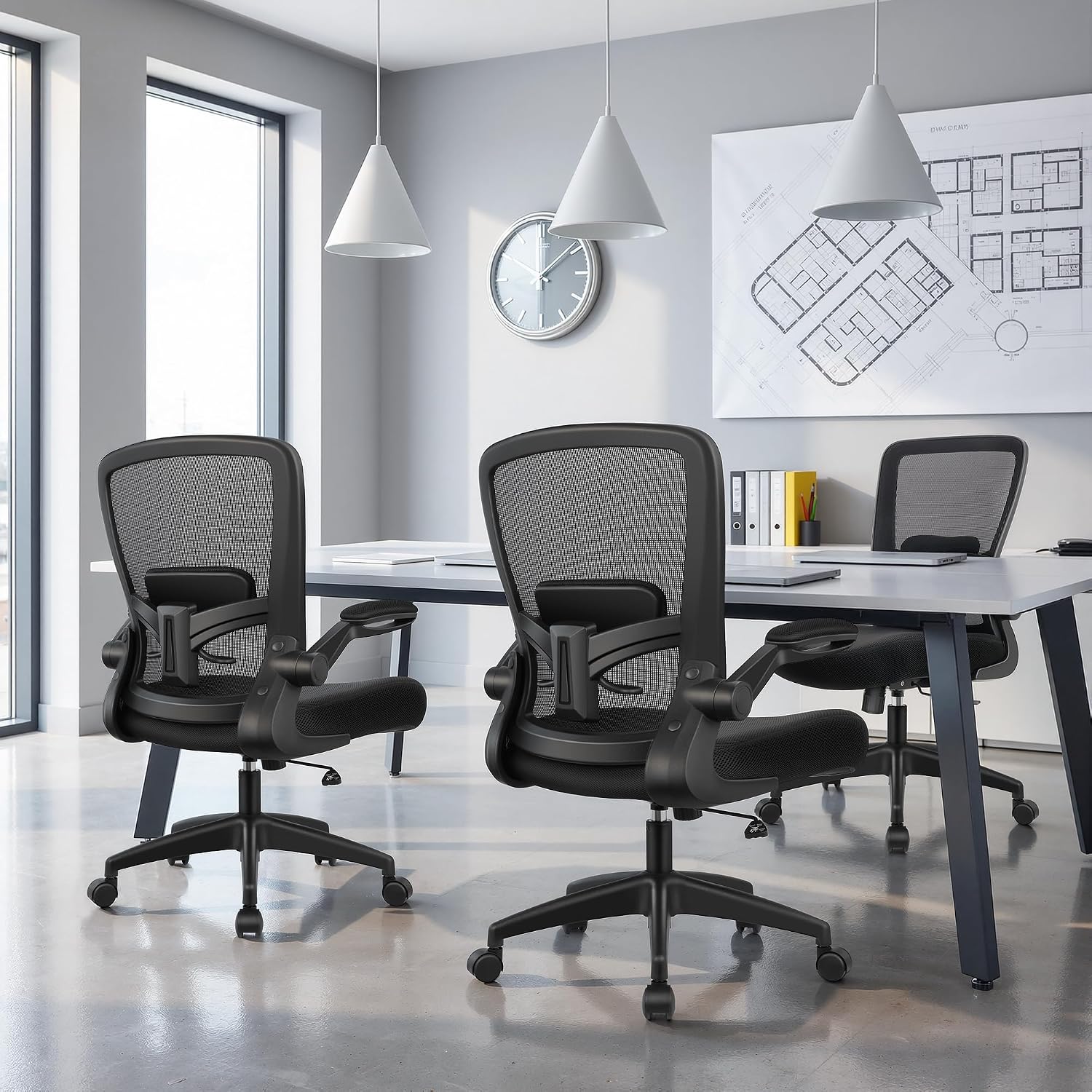 Shown in a shared office setup. The flip-up armrests are the reason these tuck under a desk.
The specs that matter
| Spec | FelixKing | Why it matters |
|---|---|---|
| Price | ~$129.99 list (often discounted) | Mid-budget tier |
| Weight capacity | 300 lb | Above the $130 norm (250 lb) |
| Gas lift | Three-stage (Class 3) | Office-standard, not heavy-duty |
| Warranty | 5 years | Rare at this price |
| Back | Breathable mesh, high back | Cooler than PU leather |
| Lumbar | Adjustable pad | Height-adjustable, not depth |
| Armrests | Flip-up, fixed height | Not adjustable |
| Base | Five-star, PU casters | Standard |
| Assembly | ~15 min, tools included | Genuinely quick |
| Dimensions | 25.2”D x 25.2”W x 42.1”H | Check against your desk height |
Ratings at the time of writing: 4.3 / 5 from 2,562 reviews, with 2,000+ units bought in the past month. That sales volume matters more than the star average — it means parts support and a real user base behind the warranty.
How we assessed it
- Verified the specifications against the Amazon listing and the manufacturer’s claims, including the ones we then contradicted (the headrest).
- Checked the gas lift class against the published standard, which is where the interesting problem is.
- Priced the competition in the same tier as of November 2026.
- Read the weight-capacity and warranty numbers across that competitive set.
Where a claim is the brand’s own, we say so instead of repeating it as fact. That distinction is what separates a specification from marketing.
The gas lift question nobody asks
FelixKing advertises a “sturdy three-stage air rod.” In industry terms that is a Class 3 gas lift, and it is genuinely the right choice for an office chair — with one caveat worth understanding.
| Class | Cycle rating | Rated load | Typical use |
|---|---|---|---|
| Class 2 | 50k–60k | ~100 kg (220 lb) | Light home use, guest chairs |
| Class 3 | 100k+ | ~120 kg (265 lb) | Standard office chairs |
| Class 4 | 120k–200k | ~150 kg (330 lb) | Heavy-duty, 24/7, big-and-tall |
Class 3 is the sensible minimum for daily work, tested under BIFMA X5.1 and EN 1335. Nobody should buy a Class 2 chair for eight-hour days. FelixKing choosing Class 3 is a point in its favour, not a cost cut.
Now the caveat. The chair is rated to 300 lb (136 kg), but a Class 3 cylinder is rated around 265 lb (120 kg). These are not contradictory — the chair’s 300 lb figure reflects the whole assembly (five-star base, reinforced seat plate, frame), and a gas lift is not loaded the way a static weight test loads it. But it does mean something practical:
If you are near or above 265 lb, a Class 3 chair is not the honest choice for you — regardless of what the chair’s overall rating says. You want a Class 4 lift and a chair sold explicitly as big-and-tall.
That is not a knock on FelixKing specifically. It is true of almost every $130 chair, including the ones recommended next to it in every “best under $200” list. It is just rarely stated.
How to verify any chair’s lift: the class is laser-engraved on the cylinder itself. A printed sticker or a line in the marketing copy proves nothing — stickers can be changed, engravings cannot.
How it compares at the same price
This is where the FelixKing case is strongest, and where it is weakest. All figures are from November 2026 listings.
| Chair | Price | Weight capacity | Warranty | Armrests | Headrest |
|---|---|---|---|---|---|
| FelixKing | ~$130 | 300 lb | 5 yr | Flip-up, fixed | No |
| Hbada Ergonomic | ~$130 | 250 lb | Not stated | Flip-up, fixed | No |
| SIHOO M18 | ~$147 | 330 lb | 3 yr | 2D adjustable | Yes |
| Duramont | ~$160 | 350 lb | 5 yr | Height adjustable | No |
| GABRYLLY | ~$180 | — | 5 yr | 4D | Yes |
| Branch (reference) | ~$345 | — | — | 4D | Optional |
Read that table as three tiers.
At $130, FelixKing and Hbada are the same chair in different clothes — same flip-up arms, same adjustable lumbar, same mesh. FelixKing wins on paper: +50 lb capacity and +5 years of warranty for the same money. That is not a marketing claim; it is the spec sheet.
At $147–160, SIHOO M18 and Duramont add what FelixKing lacks: adjustable armrests and (on the M18) a headrest. If you work long sessions and your shoulders tense up from fixed armrests, spending the extra $20–30 is the better ergonomic decision.
Above $300, you are buying materials and mechanism refinement, not capacity. Nothing about FelixKing’s spec sheet pretends to compete there.
What 2,562 reviewers at 4.3 stars tell you
A 4.3 average means roughly one buyer in nine is unhappy. Across budget mesh chairs, the complaint patterns are consistent, and they line up with what this design implies:
- Fixed armrests. The most common frustration at this tier. Height matters — if your desk is not the right height, you cannot fix it by adjusting the arms.
- Cushion firmness. High-density foam holds up better than cheap foam but starts firmer than people expect. It is a seat pad, not a full mesh seat, so it runs warmer than the backrest.
- Lumbar range. Adjustable in height, not in depth. Useful for most bodies, not enough for pronounced lumbar curves.
- Assembly. Fifteen minutes with included tools is the manufacturer’s claim, and it is consistent with this class of chair.
The honest summary: this is a competent chair at its price, not an ergonomic instrument. It will get you off a dining chair and into proper back support. It will not replace a $400 chair for eight-hour postural work.
Who should buy it
- You weigh under ~250 lb and want maximum capacity per dollar.
- You want a real warranty. Five years at $130 is the standout feature — most rivals offer three or nothing.
- Your space is tight. Flip-up armrests let the chair tuck fully under the desk, which is the single most useful feature in a small apartment.
- You run hot. Mesh back, breathable seat.
- You need it assembled in 15 minutes, not an afternoon.
Who should not
- You are near or above 265 lb. Buy a big-and-tall chair with a Class 4 lift, not a chair with a 300 lb sticker.
- You need adjustable armrests. Spend $20 more on the SIHOO M18 or Duramont.
- You want a headrest for reclining. This chair has none, whatever the bullets say.
- You work 10-hour days and care about posture. Budget chairs trade adjustability for price; that trade is fine for six hours and not for twelve.
FAQ
Is the “head support” real? No. The listing describes five support points including the head, but the chair has a tall mesh backrest and no headrest. The top of the backrest reaches neck height on most users. Treat any “head support” language here as describing the backrest, not a pillow.
Is a three-stage gas lift good? Yes, for normal office use. Class 3 is the standard for daily work chairs and is tested to 100,000+ cycles under BIFMA X5.1 / EN 1335. It is not heavy-duty — that is Class 4.
Is 300 lb capacity safe if the cylinder is rated lower? The 300 lb figure covers the whole chair, not the cylinder alone. But if you are near that limit, the responsible choice is a chair with a Class 4 lift rated for it. Do not treat a 300 lb chair rating as a licence to be a 300 lb user on a Class 3 cylinder long-term.
Will the armrests fit under my desk? The flip-up design is specifically for that. Measure your desk clearance anyway — the chair seat sits about 19.7 inches deep and 17-21 inches high depending on lift position.
Is $130 a good price for this? For 300 lb capacity plus a five-year warranty, yes. It is not a bargain on materials — it is a bargain on risk. You are buying the guarantee as much as the chair.
Mesh or foam seat? This has a foam seat pad with a mesh back. Foam is more comfortable initially and warmer over time; full mesh breathes better but costs more. At $130 you get foam.
Our verdict
4.2 / 5.
FelixKing does the unglamorous thing well: it puts a 300 lb rating and a five-year warranty on a $130 chair, and it uses the correct Class 3 gas lift rather than the cheapest one available. For a budget home-office chair, that combination is the most defensible thing in its price tier.
It loses points for fixed armrests, a lumbar pad with limited range, and a listing that oversells “head support.” And the 300 lb number deserves a footnote about gas lift classes that the brand does not provide — so we did.
Buy it if you want capacity and warranty per dollar and can live without adjustable arms — check the current price on the Black variant. Skip it if you are a heavy user needing a Class 4 lift, or you need armrest adjustment — in both cases a $20-30 step up buys you the right chair.
Prices and variants change; verify the current figure and colour before ordering.
Keep exploring
See more independent tests in the lab, or read how scores get made.