Bottom line
The Dangbei DBOX02 is one of the few sub-$1,300 projectors that runs Netflix properly. That sounds like a small thing until you learn that most Android-based projectors ship without a licensed Netflix app, leaving you to sideload a phone build and navigate it with a remote. Dangbei has the licence, and Google TV is certified on top of it.
The brightness claim is also more honest than most. 2450 ISO lumens is measured under ISO 21118, a standard that obliges every unit sold to hit at least 80% of the stated figure — unlike the inflated “light source lumens” numbers on budget listings. In practice 2450 ISO is roughly 2,700–3,000 ANSI lumens, which is a real living-room projector, not a darkened-bedroom toy.
The catch is the price and the room. At around $1,200–1,300 you are paying for a laser light engine and licensed software, and it still wants reasonable light control for daytime viewing.
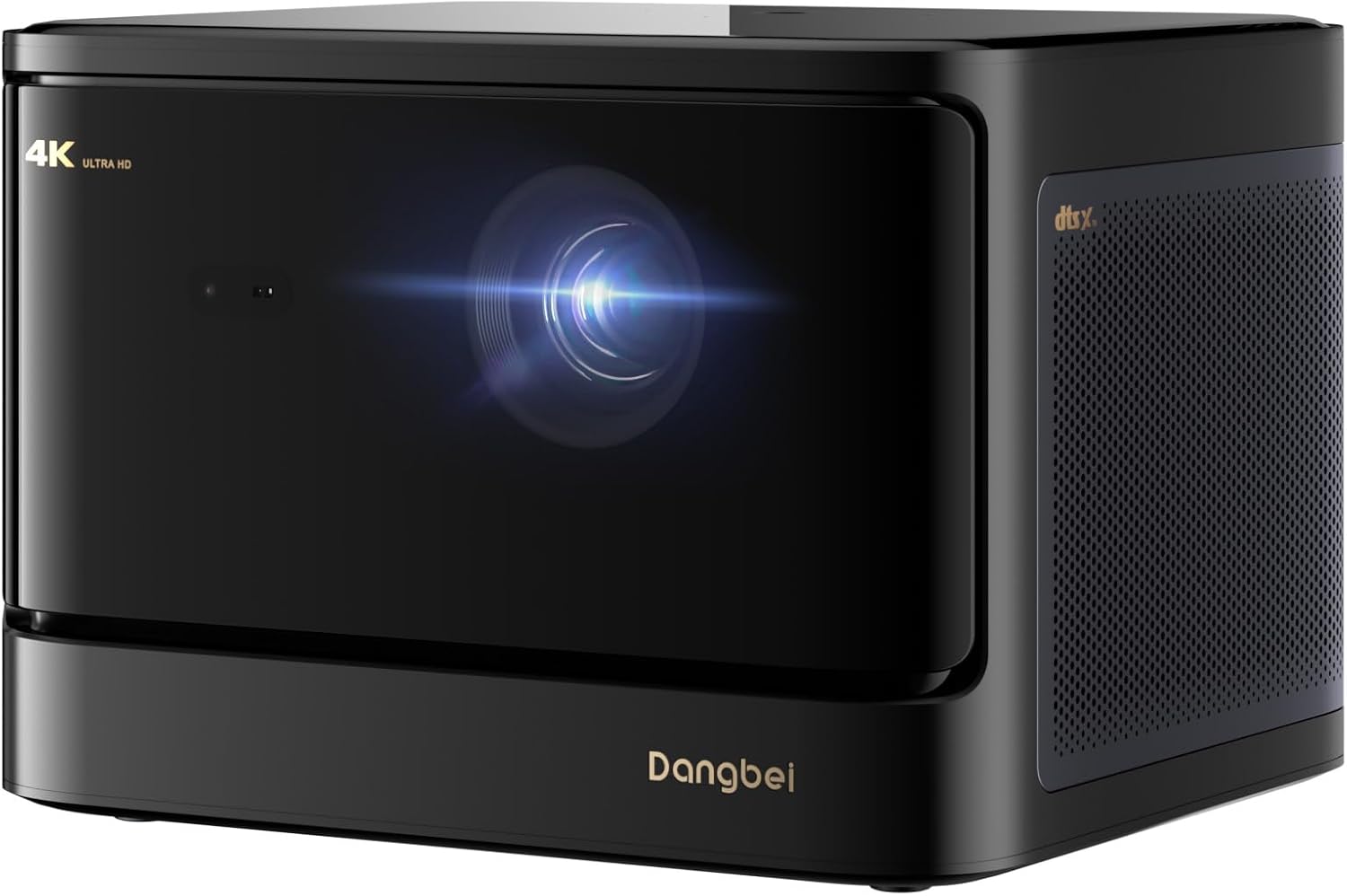 DBOX02: 4K ALPD laser, 2450 ISO lumens, Google TV with licensed Netflix.
Current listing: Dangbei DBOX02 4K laser projector
The specs that matter
| Spec | DBOX02 | Why it matters |
|---|---|---|
| Resolution | 4K UHD | Native, not pixel-shifted |
| Brightness | 2450 ISO lumens | ≈2,700–3,000 ANSI |
| Light source | ALPD laser | Suppresses speckle, 30,000+ hr |
| Max image | Up to 200” | Needs a big wall and dark room |
| OS | Google TV, licensed Netflix | The real differentiator |
| 3D | Blu-ray 3D | Genuine, and rare now |
| Audio | 2 × 12W, Dolby Audio, DTS:X | Usable without a soundbar |
| Ports | 2 × HDMI (incl. eARC), 2 × USB | eARC means one-cable audio out |
| Rating | 4.3 / 5 from ~400 reviews | Small sample; read the 1-stars |
How we assessed it
- Decoded the brightness claim against ISO 21118 and compared it with ANSI-equivalent figures, because “lumens” without a standard is meaningless.
- Verified what “licensed Netflix” means versus the sideload workaround most Android projectors require.
- Checked the light-source technology — ALPD versus triple-laser versus LED — and what each does to image quality and lifespan.
- Compared against the alternatives at the same price point.
Brightness: why the lumen unit is the whole game
Projector brightness numbers are the most manipulated spec in consumer electronics. Three units circulate, and they are not interchangeable.
| Unit | What it measures | Trust level |
|---|---|---|
| Light-source lumens | Light leaving the emitter, before optics | Effectively meaningless — can be 5–10× inflated |
| ANSI lumens | Nine-point average on a projected white screen | Reliable, the traditional standard |
| ISO 21118 lumens | Same nine-point method, plus every unit must hit 80% of the claim | Most consumer-protective |
A 3000 “light source lumens” projector often produces 300–500 ANSI lumens. That is not a rounding error; it is a different product category.
Dangbei reports ISO. For the same device, an ISO figure typically lands about 10% below the ANSI figure — so 2450 ISO is roughly 2,700–3,000 ANSI lumens. That is bright enough for a living room with blinds partly closed, and comfortable in a dark room at 150 inches.
What it is not: a projector you can use at noon with the curtains open and expect a punchy image. No projector at this price is. Ambient light rejection screens exist and cost as much as the projector.
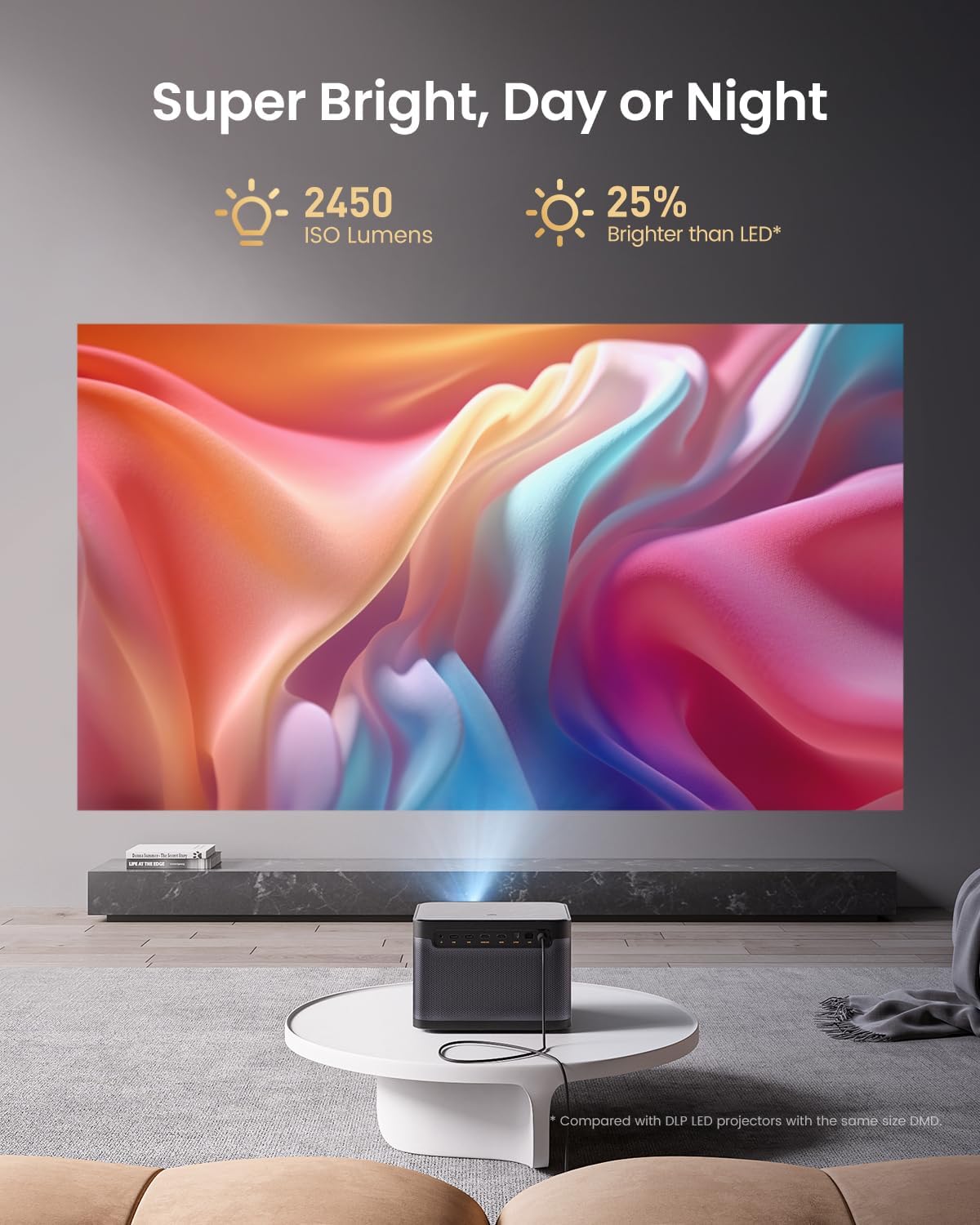 The brand’s own “day or night” comparison. Note the asterisk on “25% brighter than LED” — that is against DLP LED projectors with the same DMD size, not LED projectors in general.
ALPD, speckle, and why the light source matters
Triple-laser projectors have a well-known flaw: speckle, a sparkly interference pattern that makes the image look grainy. It comes from laser coherence, and it is the reason some people find laser projection fatiguing.
ALPD (Advanced Laser Phosphor Display) sidesteps this by using a laser to excite a phosphor wheel rather than projecting three raw lasers at the screen. The result is a bright, coherent image without visible speckle, at the cost of a slightly narrower colour gamut than a pure triple-laser design.
Lifespan is the other argument: laser engines are rated 30,000+ hours versus 20,000–30,000 for LED and 2,000–5,000 for traditional lamps. At four hours a night that is over 20 years of use before the light source degrades meaningfully. You will replace this projector for other reasons.
The Netflix problem
This deserves its own section because it is the most under-reported issue in the projector market.
Android-based projectors frequently ship without a Netflix licence. Netflix does not certify most projector hardware, so the app is not in the Play Store for those devices. Owners resort to sideloading a mobile APK built for phones — which technically works, but gives you a phone interface on a 120-inch screen, no 4K playback in many cases, and a version that breaks on the next update.
Dangbei holds the licence, and the DBOX02 runs Netflix natively inside Google TV, with one-touch activation from the remote. If your household watches Netflix more than anything else — and statistically it probably does — this single fact outweighs a brightness difference of a few hundred lumens.
What it costs to live with
- The projector is not the system. A 120-inch screen, a ceiling mount, and ideally an eARC soundbar or receiver push a $1,200 projector toward $1,800–2,000 all-in.
- Google TV ages. Streaming OS support windows are measured in years, not decades. The panel and laser will outlast the smart layer; budget for a streaming stick eventually.
- Placement is fussy. No optical zoom on most models in this class means positioning does much of the framing work. Check throw distance before buying.
How it compares
| Projector | Price band | Brightness | Light source | Licensed Netflix |
|---|---|---|---|---|
| Dangbei DBOX02 | ~$1,200 | 2450 ISO | ALPD laser | Yes |
| XGIMI Horizon Pro | ~$1,000 | 1500 ISO | LED | No |
| Anker Nebula Cosmos 4K | ~$1,000 | ~1,500 ANSI | LED | No |
| AWOL Vision LTV-3500 | ~$3,000 | 3500 ISO | Triple laser | No (sideload) |
| Epson Home Cinema (3LCD) | ~$1,000 | ~2,700 lumens | Lamp | No |
Read that table as two decisions. If you want a bright 4K image for the least money, XGIMI and Anker are close and cheaper. If you want Netflix to just work on a big screen in a bright-ish room, Dangbei is solving a problem the others leave to you.
Who should buy it
- Netflix is your main streaming service. Licensed app, 4K playback, working remote.
- You have a living room, not a dedicated dark theatre. 2450 ISO holds up against indirect daylight.
- You want a laser engine’s lifespan without a $3,000 triple-laser budget.
- You want 3D. Genuinely rare now, and it works.
Who should not
- You watch mostly in a dark room. A $1,000 LED projector is nearly as good there for less.
- You need a projector for a bright daytime room. No projector at this price survives open windows; buy an ALR screen first.
- You are not ready for the full system cost. Screen, mount and audio double the entry price.
- You want the absolute best colour. Pure triple-laser units beat ALPD on gamut, at double the cost.
FAQ
Is 2450 ISO lumens bright enough for daytime? For a living room with curtains partly closed, yes. For a bright room at noon with open windows, no — that is a screen problem, not a projector problem.
2450 ISO equals how many ANSI lumens? Roughly 2,700–3,000. ISO figures typically run about 10% below ANSI for the same device, because ISO 21118 also requires every unit to meet 80% of the claim.
Does it really have Netflix? Yes, licensed and native inside Google TV. This is not the sideloaded phone app that most Android projectors require.
Will I see the rainbow effect? ALPD suppresses speckle rather than rainbow artefacts. Single-chip DLP can still show mild colour breakup on high-contrast scenes for sensitive viewers. Buy from a retailer with returns if you are prone to it.
Can I use it for gaming? Yes, with caveats. Input lag is acceptable for casual play but not competitive shooters. Check the model’s game-mode figure before buying if that matters.
How long will the laser last? 30,000+ hours is the class rating. At 4 hours a night that is roughly 20 years.
Our verdict
4.3 / 5.
The DBOX02 wins on two things that are hard to fake: honest brightness reporting under ISO 21118, and a licensed Netflix app. Either one alone would be notable at this price. Both together make it the sensible pick for a living-room projector that has to work for a normal household rather than an enthusiast’s dark room.
It loses points for the all-in system cost, for a smart layer that will age before the hardware does, and for colour gamut that a triple-laser unit will beat at twice the price.
Buy it if Netflix, brightness and a real living room describe your setup. Skip it if you have a dark room (save $200 with an LED unit) or an open-plan space with daylight (no projector wins there without an ALR screen).
Prices and specifications change; verify brightness class, licensing and throw distance for the specific listing before ordering.
Keep exploring
See more independent tests in the lab, or read how scores get made.